
“A time of crisis is not just a time of anxiety and worry. It gives a chance, an opportunity to choose well or to choose badly.”
— Desmond Tutu
Introduction
Can managers and organizational leaders make a difference to employee mental health?
Employee mental health is an important part of creating a healthy, productive, and supportive workplace. During times of crisis, employees can experience uncertainty, stress, financial concerns, changes in working conditions, and pressure from responsibilities at home.
The COVID-19 pandemic demonstrated how quickly these challenges can affect both organizations and their employees. Lockdowns, social distancing, reduced staffing, financial uncertainty, pay cuts, job losses, and increased workloads created significant pressure across many sectors.
Employees who continued working were not immune to these challenges. Working from home, being separated from colleagues, worrying about job security, and managing family responsibilities could all affect employee mental health and workplace wellbeing.
The World Health Organization recognizes that working environments can influence mental health and recommends organizational measures, manager training, open communication, and appropriate support for workers.
This raises an important question:
Can managers and organizational leaders make a difference to employee mental health?
The answer is yes.
Managers are often in a unique position to notice changes in their employees, encourage communication, provide support, and help create a healthier work environment. Here are six practical ways managers can support employee mental health during difficult times.A supportive conversation can help employees feel heard during a crisis.
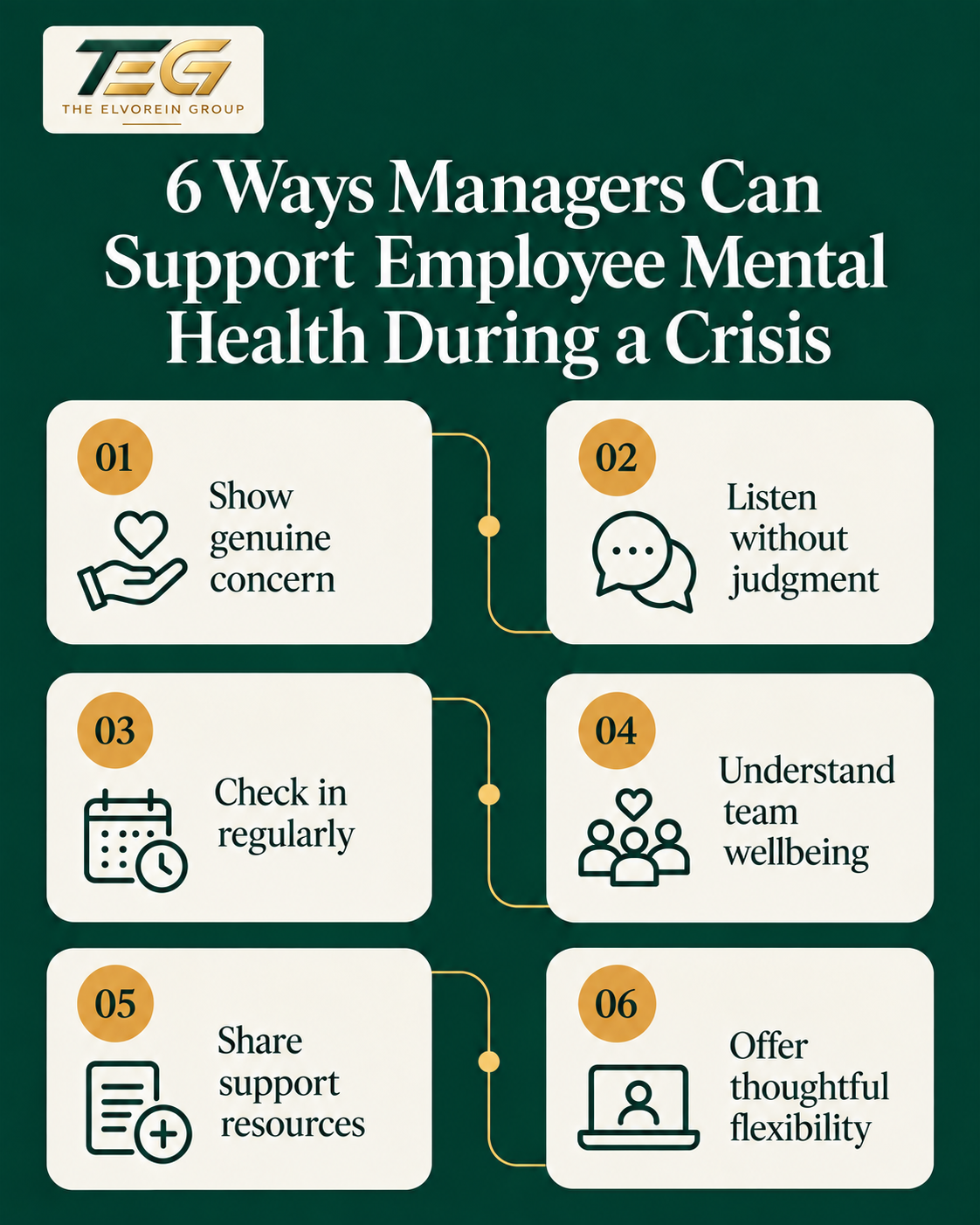
1. Show Concern and Support Employee Mental Health
Sometimes, a simple question can make a significant difference.
When employees are working remotely or dealing with difficult circumstances, they may feel disconnected from their organization. A manager who takes the time to ask, “How are you doing?” or “Are you okay?” can communicate something extremely important:
“Your wellbeing matters to us.”
Showing genuine concern and empathy can help employees feel valued and supported. Not everyone will respond in the same way. Some employees may openly share their concerns, while others may hesitate or choose not to discuss their problems.
Managers should respect these differences while continuing to remain approachable.
A simple conversation can create an opportunity for an employee to express concerns that they may otherwise keep to themselves. During a crisis, demonstrating empathy is not simply a management practice—it is an important part of supporting employee mental health.
2. Be a Good Listener
Showing concern is only the first step. Managers must also be willing to listen.
When an employee opens up about a personal or professional difficulty, the immediate response should not always be to provide advice or a solution. Sometimes, employees simply need someone who will listen without judgment.
Empathetic listening can help employees organize their thoughts, gain clarity, make better decisions, and cope with challenging situations. It can also strengthen trust between managers and employees.
The World Health Organization specifically highlights open communication and active listening as important skills for managers who support mental health at work.
Managers can become more approachable by appropriately sharing experiences of their own. When employees see that their managers are also navigating uncertainty and challenges, they may feel less alone and more comfortable communicating openly.
Mental health challenges do not belong to one particular level of an organization. From senior executives and managers to frontline employees and support staff, everyone can experience stress and uncertainty.
Recognizing this shared vulnerability can encourage people to support one another and make employee mental health a shared workplace priority.

3. Make Mental Health Conversations Consistent
Supporting employee mental health should not be a one-time activity.
A single conversation cannot address every challenge an employee may face. Genuine support requires sincerity, consistency, and regular communication.
Managers should make an effort to check in with employees regularly and create opportunities for open conversations about wellbeing. However, communication should also be thoughtful and individualized. Different employees may prefer different communication styles, and managers should understand what works best for each person.
Regular conversations can provide employees with an outlet for their concerns before stress becomes overwhelming.
The goal is not to pressure employees into discussing personal matters. Instead, managers should create an environment where employees know that support is available when they need it.
Consistent communication can therefore play an important role in maintaining employee mental health and workplace wellbeing.
4. Keep a Regular Check on Employee Wellbeing
Employee wellbeing should be considered at every level of an organization.
It is important to remember that managers and leaders also need support. Organizations should therefore look beyond individual employees and regularly assess how different teams, departments, and branches are coping.
Regular surveys or feedback mechanisms can help organizations understand employee concerns and identify areas where additional employee mental health support may be required.
The information gathered can then help organizations develop better approaches to:
- Communicating with employees
- Supporting employee wellbeing
- Identifying workplace concerns
- Preventing a decline in mental wellbeing
- Creating a more supportive work environment
The purpose of monitoring should not be to scrutinize employees. It should be to understand their needs and respond appropriately.
When organizations regularly listen to their people, they are better positioned to identify challenges affecting employee mental health and take meaningful action.
5. Make Employee Mental Health Resources Available
Providing support is meaningful only when employees know where and how to access it.
Employees may not always be aware of the mental health resources available within their organization. Companies should therefore clearly communicate the support systems they have in place.
Depending on the organization’s resources, this could include access to:
- Counselling services
- Mental health professionals
- Psychological support
- Mental health awareness resources
- Practical assistance during difficult circumstances
The World Health Organization recommends that employers and organizations take steps to prevent mental health risks, promote mental health, and support workers experiencing mental health conditions.
During situations such as quarantine or isolation, employees and their families may also face practical challenges. Even seemingly small forms of assistance can become extremely valuable during a crisis.
Managers can help by understanding these challenges and guiding employees toward available organizational resources and appropriate support.
Providing accessible employee mental health resources demonstrates that an organization takes employee wellbeing seriously.
Mental health support should not be viewed simply as an expense.
It is an investment in people.
6. Be Gender-Sensitive and Flexible
A crisis does not affect every employee in the same way.
Employees may have different responsibilities at home, and managers need to recognize these differences when planning workloads and expectations.
During the COVID-19 pandemic, for example, many women working from home faced the challenge of managing professional responsibilities alongside childcare and household responsibilities. Being physically present at home did not necessarily mean being free from family responsibilities.
Managers should therefore consider the circumstances of individual employees and provide reasonable flexibility wherever possible.
This does not mean lowering standards or expectations. Rather, it means recognizing that employees are human beings with responsibilities beyond the workplace.
A flexible and understanding approach can help employees manage competing demands while maintaining their professional responsibilities. Flexible working arrangements are also among the organizational approaches recommended by the World Health Organization for supporting mental health at work.
Flexibility can therefore contribute positively to employee mental health, workplace wellbeing, and employee engagement.

Why Employee Mental Health Matters to Good Leadership
Difficult times can reveal the true character of leadership.
A manager’s role during a crisis is not limited to assigning tasks, tracking performance, or meeting deadlines. Effective leadership also involves understanding people, listening to their concerns, communicating consistently, and creating an environment where employees feel supported.
The International Labour Organization notes that psychosocial risks at work can be related to workload, work pace, job security, organizational culture, relationships at work, and the interaction between work and home responsibilities.
Supporting employee mental health therefore requires more than policies and programs. It requires everyday actions.
A simple check-in.
A listening ear.
A little flexibility.
Access to the right resources.
A willingness to understand.
These actions can make a meaningful difference.
Conclusion
Difficult times can be opportunities to demonstrate responsible and compassionate leadership.
We may all experience uncertainty differently, but difficult circumstances remind us that we are connected by our shared humanity. Managers and organizations have an important role to play in creating an environment where people can communicate openly and seek support when they need it.
By showing concern, listening with empathy, communicating consistently, monitoring wellbeing, providing appropriate resources, and offering flexibility, managers can make a meaningful contribution to employee mental health.
Supporting people during difficult periods is not simply good management. It is good leadership.
Great leadership is not only about guiding people toward organizational goals. It is also about ensuring that people do not feel alone while pursuing them.
Let us navigate difficult times with integrity, empathy, compassion, and a genuine commitment to employee mental health.
Helpful Resources
For readers who want to learn more about workplace mental health, these authoritative resources can provide additional guidance:
One Response