A practical guide for organisations preparing people and roles for AI automation and changing business needs
Employee reskilling has become a business priority as artificial intelligence, automation and changing operating models reshape the capabilities organisations need. The question is no longer whether workplace skills will change. It is whether organisations can prepare their people quickly enough to respond without losing valuable experience, continuity and trust.
Recruiting new talent will remain necessary, particularly when an organisation needs capabilities that do not exist internally. Yet hiring alone cannot solve a continuous skills challenge. A stronger response combines selective recruitment with structured employee development, practical learning and opportunities for people to apply new skills in real work.
The Business Case for Employee Reskilling
Technology is changing both the tools people use and the tasks attached to their roles. Digital platforms have altered customer expectations. AI is accelerating research, analysis, content production and decision support. Cloud systems, automation and data-led processes are changing how organisations coordinate work across locations and functions.
The scale of this transition is significant. The World Economic Forum’s Future of Jobs Report 2025 found that employers expect 39% of workers’ existing skill sets to be transformed or become outdated between 2025 and 2030. The same research estimates that 59 out of every 100 workers will require training by 2030. These findings do not suggest that most jobs will simply disappear. They show that many jobs will be redesigned, with different combinations of technical, cognitive and human capabilities.
Source: World Economic Forum, Future of Jobs Report 2025
How Technology Is Changing Workplace Skills
The fastest-growing capabilities are not limited to technical expertise. The World Economic Forum identifies AI and big data, networks and cybersecurity, and technological literacy among the skills growing most rapidly in importance. It also highlights analytical thinking, resilience, flexibility, leadership, creative thinking and lifelong learning.
This combination matters. Employees may need to use new systems, interpret data and work alongside AI-enabled tools, but they must also evaluate outputs, make sound judgements, communicate clearly and manage change. Technical training without contextual thinking can produce tool users who struggle to solve business problems. Soft-skills training without digital exposure can leave employees confident but unprepared for redesigned workflows.
Effective workforce reskilling therefore connects technology with the realities of a role. A finance team may need data visualisation and automated reporting skills. A sales team may need to use customer intelligence responsibly. Managers may need to redesign work, coach people through uncertainty and decide which tasks should remain human-led.
The Business Case for Employee Reskilling
When a skill gap appears, leaders often compare two choices: develop existing employees or replace them with people who already possess the required skills. The real decision is more nuanced. Both options involve direct and indirect costs, and both should be assessed against the organisation’s future capability needs.
Reskilling Existing Employees vs Hiring New Talent
Developing current employees requires investment in assessment, learning design, facilitation, technology and time away from regular responsibilities. Productivity may temporarily slow while people practise unfamiliar skills. The return appears when employees use those capabilities to improve performance, move into emerging roles or reduce dependence on external hiring.
External recruitment brings different costs, including sourcing, selection, onboarding and the time required for a new employee to understand the organisation. Replacing people can also reduce institutional knowledge and affect morale if employees believe that changing capability requirements automatically place their jobs at risk.
The best strategy is rarely to choose one method exclusively. Organisations should reskill where employees have transferable strengths and a realistic pathway to future roles, while recruiting externally for genuinely scarce expertise or capacity that cannot be developed within the required timeframe.
Benefits of Developing Existing Employees
Improved Retention and Morale
Visible investment in development signals that employees have a future within the organisation. When learning is connected to meaningful career opportunities, people are more likely to see change as a pathway for growth rather than a warning of redundancy.
Lower Replacement and Onboarding Costs
Employees who already understand customers, processes and organisational culture can often apply new skills faster than someone learning both the role and the business simultaneously. Reskilling can therefore protect institutional knowledge while addressing emerging requirements.
Greater Organisational Adaptability
A workforce that is accustomed to learning can respond more effectively when technologies, regulations or customer expectations change. Adaptability becomes an operating capability rather than an emergency response.
Stronger Employer Brand
A credible development culture helps organisations attract people who value growth. It also strengthens the employment proposition because the organisation can demonstrate how learning connects with performance, mobility and future opportunity.
Skills Organisations Should Develop
The right capability mix will differ by sector, strategy and role. However, most organisations should assess four connected areas:
• Digital and technology skills, including responsible AI use, data literacy, cybersecurity awareness and relevant business systems.
• Analytical and problem-solving skills that help employees interpret information, question assumptions and make evidence-based decisions.
• Communication and emotional intelligence, particularly for collaboration, stakeholder management, coaching and customer-facing work.
• Adaptability and creative thinking, which help employees work through unfamiliar problems and improve established processes.
A long list of popular skills is not a strategy. Each capability should be connected to a business objective, a defined audience and a clear situation in which employees are expected to use it.
How to Create an Employee Reskilling Strategy
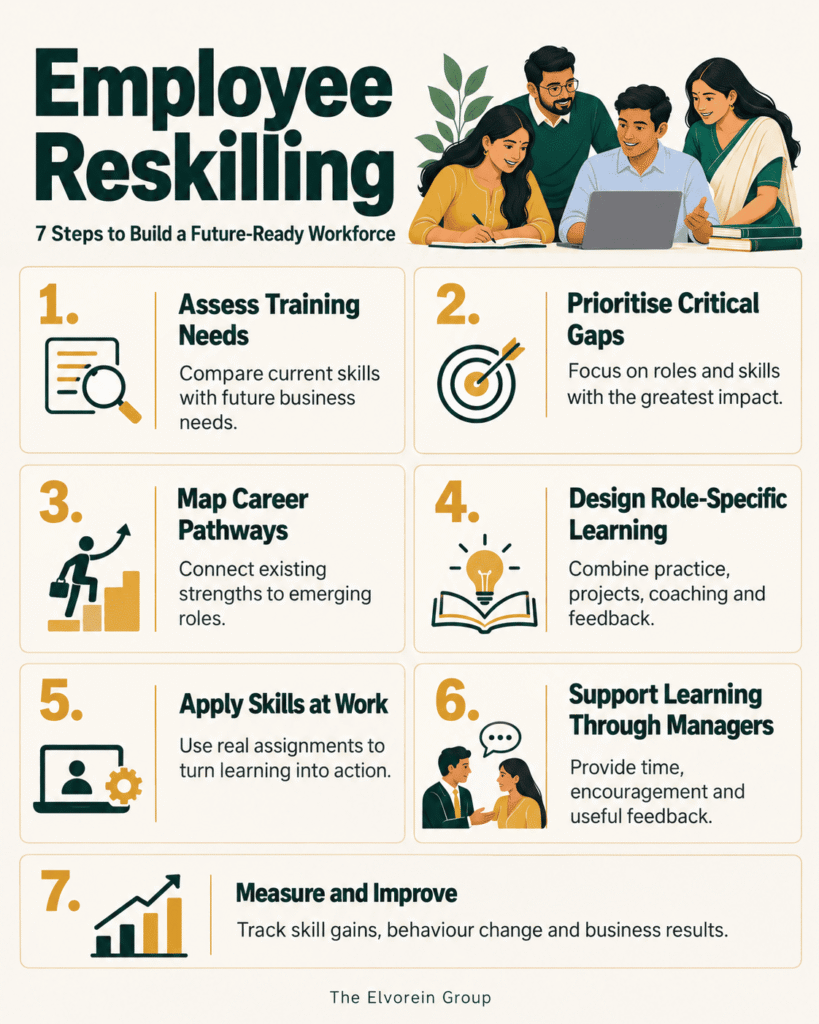
1. Conduct a training needs analysis. Begin with the performance or business problem. Compare the organisation’s current capabilities with those required by its strategy, technology roadmap and changing roles.
2. Prioritise critical roles and skill gaps. Focus first on capabilities that affect service delivery, growth, compliance, customer experience or operational continuity. Not every gap requires immediate intervention.
3. Identify realistic mobility pathways. Map declining or changing tasks to emerging responsibilities. Look for transferable strengths so employees can see how their experience connects with a future role.
4. Design role-specific learning. Combine short conceptual inputs with guided practice, projects, coaching and feedback. Generic workshops may build awareness, but application requires relevance and repetition.
5. Create opportunities to apply new skills. Give employees assignments, simulations or supervised responsibilities that allow them to use what they have learned. Without application, training is easily forgotten.
6. Equip managers to support learning. Managers influence whether employees receive time, encouragement and useful feedback. Their role should be defined before a programme begins.
7. Measure outcomes and improve. Track completion, but do not stop there. Measure capability improvement, behaviour change, internal mobility, performance and the business results connected to the original need.
What Makes a Reskilling Programme Effective
Successful programmes begin with diagnosis rather than a preselected workshop. A training needs analysis helps distinguish a genuine capability gap from problems caused by unclear processes, inadequate tools, weak incentives or poor role design. Training cannot repair every performance problem, and treating it as a universal solution wastes time and reduces confidence in learning initiatives.
Learning must also be accessible and supported. Employees need clarity about why a capability matters, how it affects their role and what opportunity follows. Managers need practical guidance for reinforcing new behaviours. Leaders need evidence that development is contributing to business priorities.
Partnerships can extend this work. Organisations may collaborate with specialist learning providers, educational institutions, industry bodies or public agencies to share expertise and create relevant pathways. The value of a partnership, however, depends on how well the learning is adapted to the organisation’s context.
Employee Reskilling Is an Investment in Business Continuity
Skills will continue to evolve as technology and business models change. Organisations cannot predict every future role, but they can build a workforce that is better prepared to learn, adapt and move where its capabilities are needed.
Employee reskilling is therefore more than a learning initiative. It is a practical approach to workforce planning, retention and organisational resilience. When companies identify the right gaps, design learning around real work and measure meaningful outcomes, development becomes an investment in both people and performance.
Ready to understand which capabilities your organisation needs next? The Elvorein Group can support training needs analysis, role-focused learning design and workforce development aligned with business priorities.
The Elvorein Group
SEO Publishing Details
| Parameter | Recommended value |
| Focus keyword | Employee Reskilling |
| SEO title | Employee Reskilling: Build a Future-Ready Workforce |
| Permalink | employee-reskilling-future-ready-workforce |
| Meta description | Employee reskilling helps businesses close skill gaps, retain talent, improve productivity, and prepare their workforce for AI and automation. |
| Featured image filename | employee-reskilling-future-ready-workforce.webp |
| Featured image alt text | Employee reskilling programme for building a future-ready workforce |
| Category | Learning and Development |
| Schema | BlogPosting or Article |
| Robots | Index, Follow |
Suggested Supporting Keywords
Workforce reskilling, employee upskilling, future-ready workforce, workplace skill gaps, learning and development, digital skills training, AI and automation skills, and employee development strategy.
The Elvorein Group