


Happy workplace may sound like a simple idea, but creating one requires much more than occasional celebrations or office perks. A truly happy workplace is built on trust, respect, meaningful relationships, employee wellbeing, opportunities to grow, and a culture where people feel valued.
In the hustle and bustle of modern life, happiness can sometimes seem like a rare feeling. But happiness does not have to remain outside the workplace. Organizations can consciously create environments where employees feel supported, respected, motivated, and connected.
he World Happiness Report highlights social support, trust, safety and healthy lives as important contributors to wellbeing
This raises an important question:
How can organizations create a happy workplace where employees and the organization can grow together?
The answer begins with understanding that people are at the heart of every organization.
What Makes a Happy Workplace?
A happy workplace is not simply a place where employees have fun. It is an environment where people feel that their work matters, their opinions are valued, their growth is supported, and their wellbeing is respected.
Research has also connected workplace happiness with productivity. The original article refers to research from the University of Warwick that found a positive relationship between happiness and productivity, while also highlighting examples of organizations investing in employee support and satisfaction.
A happy workplace can therefore benefit both employees and organizations.Research from the University of Warwick found a positive relationship between happiness and productivity.
Here are six practical ways organizations can build one.
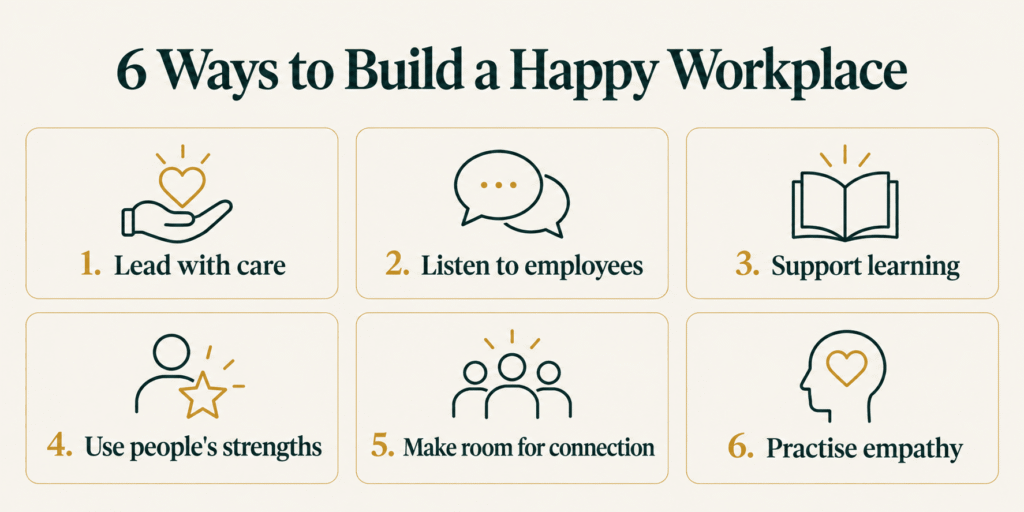
1. Start With Strong Commitment From Top Management
The creation of a happy workplace begins with leadership.
Top management must genuinely believe that creating a positive workplace is important. This commitment cannot remain limited to speeches, policies, or corporate statements. Employees need to experience it through everyday decisions and behaviour.
Leaders should demonstrate that employees are valued assets rather than simply resources used to achieve organizational targets.
Respect, empathy, fairness, and trust should become part of the organization’s leadership philosophy.
The original article describes the will of top management to transform the workplace as a foremost requirement and emphasizes the importance of treating employees with value and regard.
When leadership genuinely prioritizes people, it creates the foundation for a happy workplace culture.
2. Listen to Employees and Learn From Their Experience
Who can explain what makes a workplace better than the people who actually work there?
Employees experience the organization’s culture every day. They know its strengths, challenges, bottlenecks, and opportunities.
Therefore, organizations should create comfortable and respectful opportunities for employees to share their views.
Managers can ask employees:
- What makes this organization a good place to work?
- What challenges affect your performance?
- What could make your work experience better?
- Do you feel your contributions are valued?
- What opportunities would help you grow?
- How can the workplace culture improve?
The original article recommends speaking with high performers as well as employees who may be facing performance challenges to understand strengths, drawbacks, expectations, and areas for improvement.
However, asking questions is only the beginning.
Managers must listen.
Employees should feel that their opinions are heard with an open mind rather than being dismissed or judged.
When organizations listen carefully and act on meaningful feedback, employees are more likely to feel respected and involved. This can strengthen the foundation of a happy workplace.
3. Build a Learning and Growth Culture
Learning creates opportunities for reinvention, innovation, and personal growth.
A workplace where employees can continuously learn new skills can help break monotony, improve competencies, encourage collaboration, and create new opportunities.
The original article describes a learning culture as a way to support cooperation, shared knowledge, employee engagement, growth, and new opportunities.
Organizations can encourage learning through:
- Training programs
- Workshops
- Mentoring
- Knowledge-sharing sessions
- Cross-functional projects
- Skill-development opportunities
- Opportunities to experiment with new ideas
But learning alone is not enough.
Employees also need opportunities to apply what they learn.
The original article points out that learning without scope or autonomy to apply newly developed competencies can be detrimental to both the individual and organization.
Giving employees the freedom to use their skills can increase ownership, confidence, creativity, and motivation.
A workplace that supports both learning and application is more likely to become a genuinely happy workplace.
4. Give Employees Opportunities to Use Their Talent
Every employee brings different skills, interests, experiences, and abilities to an organization.
However, talent can become frustrating when people do not have opportunities to use it.
Employees need a conducive workspace where they can apply their knowledge and skills. Organizations should therefore identify employee strengths and create opportunities for people to contribute beyond routine tasks whenever possible.
This could include:
- Assigning employees to projects that match their strengths
- Encouraging creative ideas
- Giving employees appropriate autonomy
- Allowing people to take ownership of projects
- Creating opportunities for cross-team collaboration
- Recognizing useful contributions
When employees can see how their abilities contribute to organizational goals, work can become more meaningful.
This sense of contribution can strengthen engagement and help create a happy workplace where people feel that their talents are being recognized.
5. Keep the Fun Side of Work Alive
Work is important, but work does not have to be joyless.
The original article reminds us that the idea of balancing work with play applies to adults as well. It encourages organizations to create opportunities for employees to experiment, enjoy themselves, celebrate, and connect with colleagues.
Workplace activities can include:
- Team lunches
- Birthday celebrations
- Festival celebrations
- Sports competitions
- Cultural activities
- Music and dance
- Talent competitions
- Team outings
- Games and informal gatherings
The goal is not to turn the workplace into a playground.
The goal is to create moments where employees can relax, connect, and build relationships beyond their regular tasks.
The original article also highlights activities such as cultural and sports competitions, outbound training, team lunches, and family outings as ways to create bonding, motivation, freshness, and enjoyment.
These activities can contribute to a more energetic and connected happy workplace.
6. Create an Empathetic and Cooperative Culture
Fun activities alone cannot create lasting workplace happiness.
At the heart of every successful happy workplace is a culture of empathy, cooperation, understanding, and growth.
Employees may face personal challenges, professional difficulties, performance pressures, or uncertainty. Managers should be able to understand these challenges without immediately judging the individual.
Empathy does not mean ignoring performance expectations.
It means understanding the person behind the performance.
Organizations can build an empathetic culture by:
- Encouraging respectful communication
- Supporting employees during difficult periods
- Promoting cooperation instead of unnecessary competition
- Recognizing employee contributions
- Creating psychologically supportive environments
- Providing opportunities for professional growth
- Encouraging managers to listen before responding
The original article concludes that an empathetic and cooperative organizational culture, combined with understanding employees’ problems and creating learning and growth opportunities, can make a significant difference.
That is the foundation of a sustainable happy workplace.
The Ubuntu Lesson: Happiness Is Shared
One of the most memorable ideas in the original article comes from Ubuntu, an African philosophy emphasizing our shared humanity.
The article describes a story in which children were given the opportunity to race toward a basket of fruit. Instead of competing individually, the children held hands, reached the basket together, and shared the fruit.
When asked why they had done this, their response reflected a powerful idea: happiness becomes meaningful when it is shared.
The original article connects this philosophy to organizations and the workplace.
The lesson for organizations is simple:
A workplace becomes happier when people do not have to succeed at the expense of one another.

Collaboration, cooperation, trust, and mutual support can create an environment where employees celebrate not only their own success but also the success of their colleagues.
Why Workplace Happiness Matters
Workplace happiness should not be treated as a superficial trend.
When employees feel respected, supported, connected, and motivated, they may be more willing to contribute ideas, collaborate with colleagues, learn new skills, and take ownership of their responsibilities.
The original article connects workplace happiness with productivity and highlights research suggesting that positive emotions can contribute to more effective use of working time.
This means creating a happy workplace is not simply about making employees feel good.
It can also contribute to:
- Better employee engagement
- Stronger workplace relationships
- Greater motivation
- Learning and development
- Collaboration
- Creativity
- Employee wellbeing
- A healthier organizational culture
How Leaders Can Start Creating a Happy Workplace
Organizations do not necessarily need expensive programs to begin improving workplace happiness.
Small, consistent actions can have a meaningful impact.
Start by asking employees what they need.
Listen to their answers.
Recognize their contributions.
Give them opportunities to learn.
Allow them to use their talents.
Create moments for fun and connection.
And most importantly, build a culture where people treat one another with empathy and respect.
A happy workplace is created through everyday behaviour—not just occasional events.
Conclusion
Creating a happy workplace is ultimately about creating a place where people can grow, contribute, connect, and feel valued.
Leadership commitment provides the foundation.
Employee feedback provides direction.
Learning creates growth.
Talent utilization creates purpose.
Fun creates connection.
And empathy creates belonging.
It needs to be human.
The workplace does not need to be perfect to be happy.
As the philosophy of Ubuntu reminds us, happiness is not something we need to experience alone.
When organizations understand that employee wellbeing and organizational success are connected, they can begin creating workplaces where people do not simply come to work—they feel motivated to contribute, learn, collaborate, and grow.
When people feel valued, supported, and connected, everyone has a better opportunity to succeed.
That is what a truly happy workplace should be.
