
“Dreams don’t work unless you do.” — John C. Maxwell
The business world is filled with concepts, terminologies, and changing ideas. Some concepts emerge from years of research, while others develop in response to changes in organizations and society. Among these concepts, growth mindset stands out as an approach that can progressively transform individuals and organizations when it becomes part of their culture and everyday thinking.
The original article describes growth mindset as a concept that can transform people and organizations when it is properly infused into organizational DNA and the mental framework of employees.
The concept is strongly associated with Dr. Carol Dweck. According to the source article, individuals who believe that their talents can be developed through hard work, strategies, and input from others demonstrate a growth mindset, while those who believe their talents are innate gifts demonstrate a fixed mindset.
In simple terms, a growth mindset encourages people to believe that abilities can be developed, skills can be acquired, knowledge can be strengthened, and leadership capabilities can grow through continuous effort and learning.
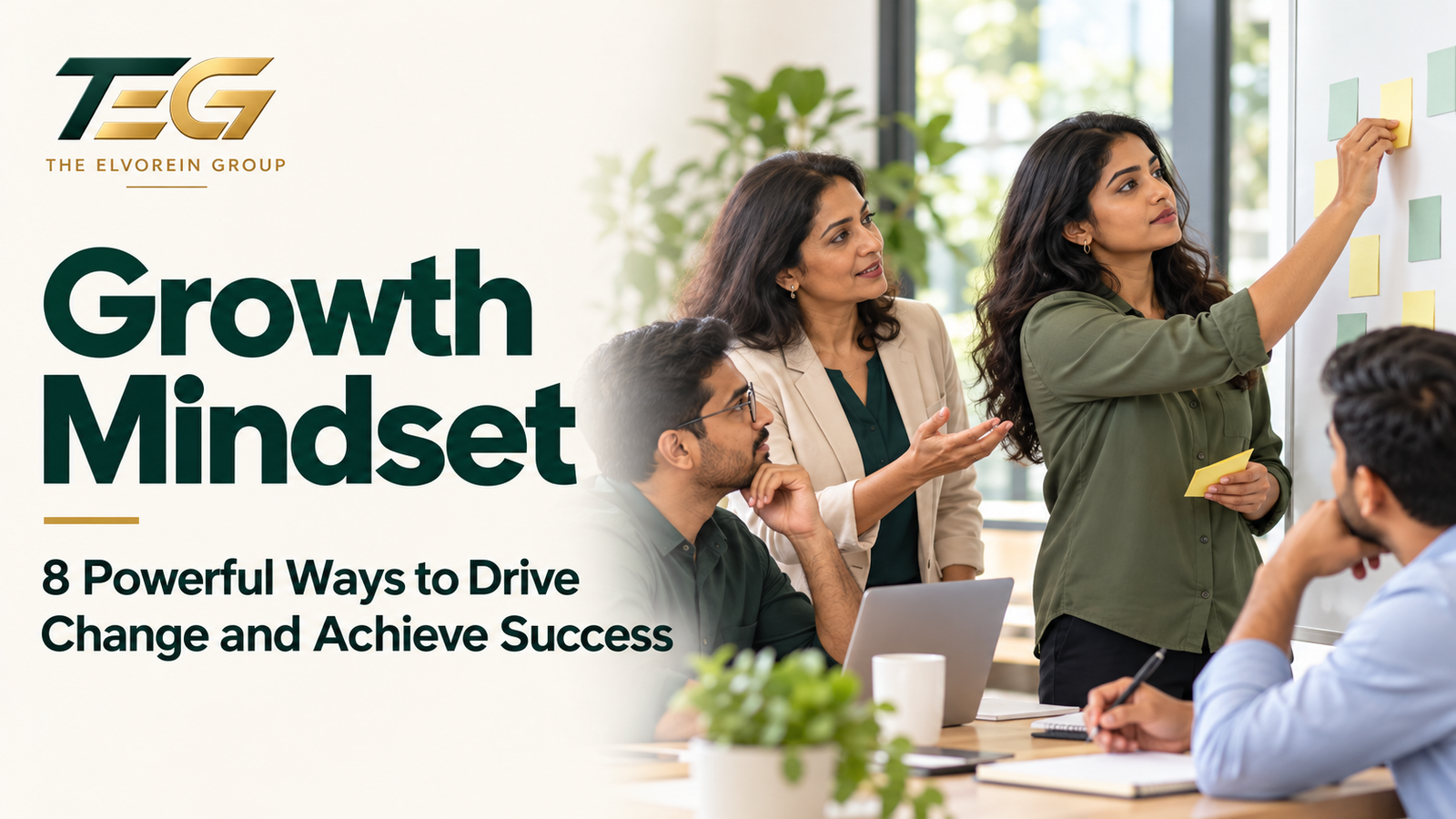
Building a growth mindset through learning, collaboration and continuous development.

What Is a Growth Mindset?
A growth mindset is an approach to learning and development based on the belief that people can improve their abilities through effort, learning, strategies, experience, and feedback.
This perspective changes how individuals look at challenges.
Instead of thinking:
“I cannot do this.”
A growth-oriented approach encourages the thought:
“I can learn how to do this.”
The source article explains that talent and competencies can be nurtured, knowledge and skills can be acquired and polished, intelligence can be augmented through cognitive activities, and leadership can be developed.
This does not mean that success comes without effort.
In fact, effort is central to a growth mindset.
The examples discussed in the source article—including Beethoven, Helen Keller, Michelangelo, P. V. Sindhu, and Opra Winfrey—are presented around the themes of effort, determination, perseverance, learning, and overcoming challenges.
Why Growth Mindset Matters in Organizations
A growth mindset in the workplace can influence how employees approach learning, challenges, mistakes, innovation, and personal development.
People with a growth mindset spend their energy learning, introspecting, adding value to themselves, and refining and reinventing their skills and talents.
When an organization incorporates a growth mindset into its policies, structures, culture, and practices, employees can feel more empowered and engaged. The source article connects this approach with an ascending trend in workforce commitment and productivity.
However, developing this culture requires deliberate action.
A growth mindset requires more than positive thinking. It involves seeking feedback, testing new strategies and taking practical steps toward improvement, as explained in this Harvard Business Review article on growth mindset.
Here are 8 powerful ways to build a growth mindset within an organization.
1. Begin With Introspection and Honest Reflection
Every meaningful change starts with understanding the current situation.
Organizations and individuals need to honestly examine the factors that may be preventing them from adopting a growth mindset.
The source article emphasizes introspection and honest admission of the obstacles that stand in the way of adopting a growth mindset at both organizational and individual levels.
Organizations can ask:
- What are we doing well?
- Where are we struggling?
- Which skills need improvement?
- Are employees encouraged to learn?
- Do managers accept feedback?
- Are mistakes treated as learning opportunities?
- Are employees taking initiative?
Honest reflection helps identify areas where improvement is possible.
Without introspection, organizations may continue following familiar patterns even when those patterns are no longer effective.
A growth mindset begins when individuals and leaders become willing to recognize what needs to change.
2. Counter Complacency and Procrastination
Growth requires action.
Complacency can prevent people from looking for better approaches, while procrastination can delay important work and learning opportunities.
The source article highlights how carelessness at work and postponing tasks can reduce productivity for both individuals and organizations.
A growth-oriented workplace can counter this by encouraging employees to:
- Take responsibility for their tasks
- Set realistic deadlines
- Start important work without unnecessary delay
- Review progress regularly
- Look for better ways of working
- Learn from previous experiences
The message from Muhammad Ali included in the source captures the importance of persistence and refusing to quit.
A growth mindset is not simply about having positive thoughts.
It is about converting those thoughts into consistent action.
3. Choose and Develop People Who Love Learning
Organizations that want a strong growth mindset culture need people who are willing to learn and develop.
Recruitment and selection should therefore consider more than existing qualifications and experience.
The source article recommends recruiting, selecting, developing, and retaining people who demonstrate a growth mindset and who have shown interest in self-development and learning in previous roles.
Organizations can look for qualities such as:
- Curiosity
- Willingness to learn
- Adaptability
- Self-development
- Initiative
- Openness to feedback
- Interest in new challenges
However, choosing learners is only the beginning.
Organizations must also create opportunities for employees to continue learning after they join.
Training programs, mentoring, coaching, knowledge sharing, and challenging assignments can help employees strengthen their capabilities.
4. Make Accountability Part of the Culture
A growth mindset and accountability should go together.
Taking ownership of failure is as important as taking ownership of success.
The source article strongly emphasizes accountability among leaders, managers, team leaders, and supervisors for the decisions, projects, and assignments they undertake.
Passing responsibility to someone else or making excuses can send the wrong message throughout an organization.
Instead, leaders should demonstrate accountability by asking:
What happened?
What can we learn from it?
What can we do differently next time?
This approach does not mean ignoring mistakes.
It means using mistakes as opportunities to improve while still maintaining responsibility for outcomes.
When leaders demonstrate accountability, employees can learn that admitting a mistake is not necessarily the end of a journey.
It can be the beginning of learning.
5. Appreciate, Encourage, and Reward Thoughtful Risk-Taking
Innovation requires people to take initiatives.
However, employees may hesitate to experiment when they believe that only successful outcomes will be appreciated.
The source article emphasizes the importance of appreciating, encouraging, and rewarding risk-taking and initiatives when they are based on proper analysis, sincere effort, accountability, integrity, and thoughtful consideration.
A strong growth mindset culture should therefore distinguish between reckless decisions and thoughtful experimentation.
Organizations can encourage a process such as:
Analyze → Take Initiative → Experiment → Learn → Improve
Not every experiment will produce the expected result.
The source article itself recognizes that initiatives or risks may not always translate into expected outcomes, but the intent, analysis, sincere effort, accountability, and integrity behind those initiatives should be encouraged.
At the same time, organizations need balance.
The source warns against costly failures and emphasizes the need for a balance when encouraging mistakes and failures as part of developing future leadership capabilities.
Therefore, thoughtful risk-taking—not careless risk-taking—should be encouraged.
6. Foster Continuous Learning
The business and technology environment changes rapidly.
Knowledge that is useful today may need to be updated or upgraded tomorrow.
This makes continuous learning an essential part of a growth mindset.
The source article emphasizes that employees need to remain on a continuous learning and growth trajectory because of rapid changes in business and technology.
Organizations can support continuous learning through:
- Regular training
- Refresher courses
- Creative-thinking sessions
- Brainstorming
- Feedback
- Work-related discussions
- Supportive guidance
- Positive conversations
- Knowledge-sharing activities
Learning should not be treated as something that happens only during formal training programs.
It should become part of everyday work.
Employees should be encouraged to ask questions, seek feedback, explore new ideas, and improve existing skills.
A growth mindset makes learning an ongoing journey rather than a one-time activity.
7. Leverage the Learning Management System
Technology can play an important role in supporting organizational learning.
A Learning Management System, or LMS, can provide employees with access to different forms of learning content.
However, simply having an LMS is not enough.
The source article emphasizes that an LMS needs appropriate digital technology, accessibility, understandable content, and updated learning resources such as articles, cases, methods, simulation videos, infographics, models, and other relevant materials.
An effective LMS should support different areas of employee development, including:
- Operational skills
- Cognitive skills
- Behavioural skills
- Creative skills
- Leadership skills
Organizations should also make sure that learning materials are relevant to different roles and jobs.
A useful learning platform should help employees improve their knowledge and skills rather than simply providing a collection of digital documents.
8. Encourage a Positive and Open Environment
A growth mindset needs an environment where people feel comfortable learning and communicating.
The source article describes a positive environment through positive conversations, positive examples, and encouragement of positive self-talk.
Leaders and managers should create an open atmosphere where employees can:
- Share information
- Learn from colleagues
- Discuss problems
- Ask managers for support
- Give their opinions
- Seek inputs
- Participate in regular discussions
The source specifically emphasizes the importance of an atmosphere where employees can share information, learn from one another, discuss problems without fear, freely express opinions, and seek inputs.
An open workplace does not mean that every idea will be accepted.
It means employees should have the confidence to contribute their ideas and learn from constructive discussions.
This kind of environment can help organizations turn individual learning into collective learning.
Growth Mindset and Leadership Development
Leadership is not necessarily a fixed quality. It can be strengthened through structured learning, feedback and workplace development. Explore The Elvorein Group’s training and consulting services for organizations and professionals.
A growth mindset in leadership means being willing to learn, accept feedback, recognize mistakes, develop new capabilities, and support the development of others.
Leaders can demonstrate this by:
- Asking for feedback.
- Accepting responsibility.
- Supporting employee learning.
- Encouraging thoughtful initiatives.
- Creating opportunities for employees to take responsibility.
- Recognizing improvement.
- Maintaining open communication.
When leaders model learning behaviour, employees can see that professional development is not limited to junior employees.
Everyone has room to grow.
Growth Mindset Is About Progress
A growth mindset does not mean that every attempt will succeed.
Failure can happen.
Plans can change.
Experiments can produce unexpected outcomes.
The important question is what individuals and organizations do after experiencing setbacks.
The source article highlights the importance of failure and quotes J.K. Rowling on the relationship between failure and greater success.
Instead of treating failure as a final destination, organizations can use it as an opportunity to reflect, learn, and improve.
This creates a culture where employees are encouraged to keep developing rather than becoming afraid of every mistake.
How to Build a Growth Mindset Culture
Building a growth mindset culture requires consistency.
It cannot be achieved simply by conducting a one-day workshop or adding the phrase “growth mindset” to a company presentation.
It needs to appear in:
- Organizational policies
- Recruitment
- Leadership practices
- Employee development
- Performance discussions
- Learning systems
- Recognition
- Risk-taking
- Workplace communication
The source article emphasizes that organizational policies, processes, and practices need to support the culture rather than merely expressing it through words.
The strongest cultures are built when what an organization says and what it actually does are aligned.
The Benefits of a Growth Mindset
A well-supported growth mindset can encourage employees to focus on:
- Learning
- Self-development
- Skill improvement
- Innovation
- Accountability
- Adaptability
- Leadership development
- Continuous improvement
The source article connects growth mindset with empowerment and engagement and describes a positive relationship with workforce commitment and productivity.
It also concludes that nurturing a growth mindset can create a stronger hunger for learning and self-development and put an organization on a journey toward growth and success.
Conclusion
A growth mindset can become a powerful vehicle for change and success when it is supported by individuals, leaders, and organizational systems.
The journey starts with introspection and honest reflection.
It continues through overcoming complacency, choosing people who value learning, taking accountability, encouraging thoughtful risk-taking, fostering continuous learning, using learning technology effectively, and creating a positive and open environment.
The most important lesson is that growth does not happen simply because an organization wants it to happen.
It happens when people are encouraged to learn, act, reflect, improve, and try again.
A growth-oriented organization therefore does not ask only:
“Did we succeed?”
It also asks:
“What did we learn, and how can we become better?”
When leaders and employees nurture a growth mindset, the organization begins a continuous journey of growth and success.
“A challenge only becomes an obstacle when you bow to it.” — Ray Davis
