

HR Analytics is transforming Human Resource Management by helping organizations make better workforce decisions using reliable data. From recruitment and employee retention to productivity and workforce planning, it enables HR professionals to replace assumptions with evidence. But my interest in HR Analytics began with something I once tried very hard to avoid: numbers.
As a child, going to school had its own share of fun and challenges. I always looked forward to English classes, where I listened to stories such as Julius Caesar and The Merchant of Venice. I listened with dreamy eyes to romantic poems like The Highwayman and with awe to the words of The Tyger. History lessons brought battles, wars, kingdoms, and civilizations to life in my imagination.
Lunch breaks were another favourite part of the school day—running out of the classroom and sharing lunch with friends was an everyday ritual.
However, everything changed when the mathematics teacher entered the classroom. I dreaded the formulas and struggled to make sense of the numbers written on the board. I grew up believing that once I entered college, I would finally escape those boring numbers.
But numbers followed me.
I completed college with a major in Zoology and later studied Management at university. Once again, I encountered numbers and data. I thought that perhaps becoming an HR manager would allow me to avoid them. But life had other plans.
I eventually entered the field of teaching and research, where I discovered something important: data, when collected and processed effectively, can sharpen research quality and improve decision-making.
Something I once disliked gradually became an area of interest.
That journey led me to explore an important development that is transforming modern [Human Resource Management —HR Analytics.
What Is HR Analytics?

According to the Chartered Institute of Personnel and Development (CIPD), people analytics uses workforce data to solve business problems and support evidence-based decisions
HR Analytics is the systematic identification and quantification of the people-related factors that influence business outcomes.
In simple terms, HR Analytics involves collecting, organizing, and analyzing HR-related data to understand workforce-related problems and their relationship with organizational objectives.
HR departments routinely collect large amounts of information about employees and organizational processes. HR Analytics helps transform this information into meaningful insights. These insights can help organizations evaluate whether HR initiatives and interventions are contributing effectively to business goals and organizational strategy.
Therefore, HR Analytics allows HR professionals to move beyond assumptions and use evidence to support important workforce decisions.
Why Is HR Analytics Necessary?
Human beings have the cognitive and intellectual ability to make decisions. However, decision-making becomes more effective when it is supported by reliable information collected systematically and analyzed scientifically.
Consider an organization experiencing [high employee turnover – ADD INTERNAL LINK].
Employee turnover can create significant challenges related to productivity, workforce stability, and organizational reputation. But simply knowing that employees are leaving does not solve the problem.
The organization needs to understand:
- Why are employees leaving?
- What factors are contributing to employee turnover?
- Which factors have the greatest impact?
- Are there identifiable patterns in employee turnover?
- Which areas should HR prioritize?
- What actions could help reduce turnover?
There may be several possible reasons for employees leaving an organization. HR Analytics helps organizations examine these possibilities using organized employee data and analytical methods.
Once the organization understands the causes and patterns behind employee turnover, it can develop more informed strategies to address the problem. This can ultimately contribute to improved productivity and [employee retention – ADD INTERNAL LINK].
In this way, HR Analytics supports evidence-based HR decision-making.
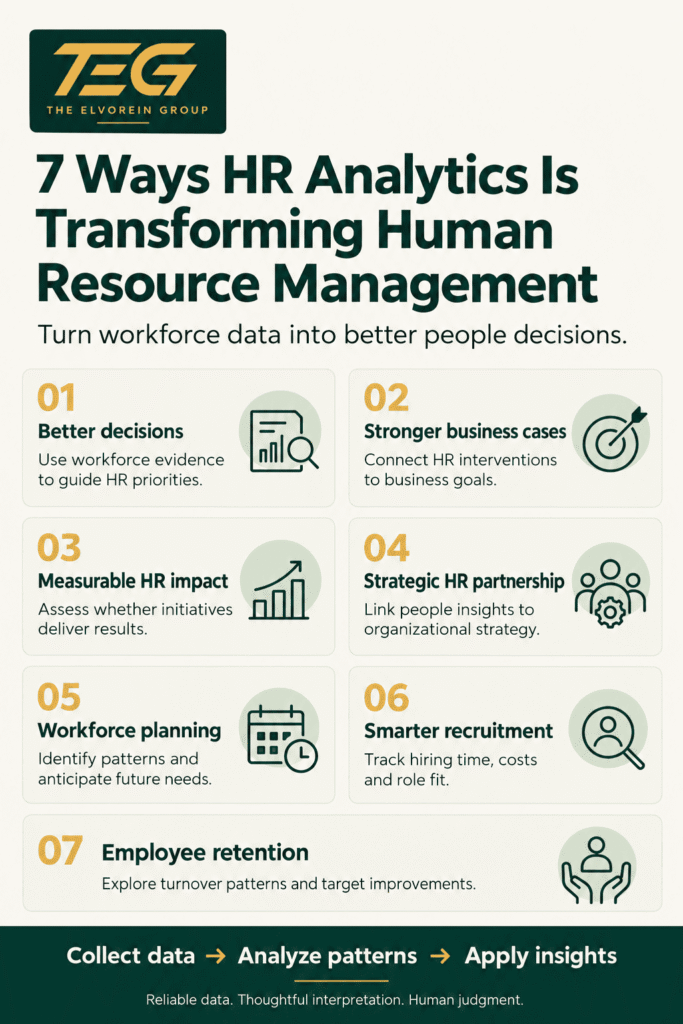
How HR Analytics Helps Human Resource Management
HR Analytics is transforming the way [Human Resource Management – ADD INTERNAL LINK] functions. By applying analytical and statistical methods to HR data, organizations can gain deeper insights into their workforce.
Some important benefits include:
1. Better Decision-Making
HR professionals can use data-driven insights to make more informed decisions about workforce management and productivity.
2. Building a Business Case for HR Interventions
HR Analytics can help demonstrate why a particular HR intervention is necessary and how it may contribute to organizational objectives.
3. Measuring the Effectiveness of HR Initiatives
Organizations can analyze data to assess whether HR interventions are producing the desired impact.
4. Moving HR Toward a Strategic Role
HR Analytics can help HR professionals move beyond routine operational activities and contribute more effectively as tactical and strategic partners within an organization.
5. Predicting Workforce Trends
By applying statistical tools to historical and current workforce data, organizations can identify patterns and develop insights that may help anticipate future workforce requirements.
HR Analytics in Recruitment
The Society for Human Resource Management (SHRM) also provides resources on using people analytics to improve workforce decisions.
Organizations collect information about candidates from multiple sources. Analyzing this information can help HR teams understand candidate profiles and make more informed recruitment decisions.
HR Analytics can support recruitment by:
- Collecting and organizing candidate information from multiple sources.
- Using historical candidate data and relevant variables to develop deeper insights into employability profiles.
- Identifying characteristics associated with high-performing employees.
- Helping organizations identify candidates whose attributes are similar to those of successful employees.
- Identifying candidates who may have a higher likelihood of leaving the organization within the first one or two years.
- Reducing the influence of personal opinions and prejudices during selection.
- Supporting a more data-driven approach to candidate-job and candidate-organization fit.
- Measuring the time required to hire candidates for specific roles.
- Tracking the cost associated with hiring.
A data-driven recruitment approach can therefore provide HR professionals with useful metrics while supporting more structured decision-making.
How Does HR Analytics Work?
The HR Analytics process can be understood through a series of important steps.
Step 1: Collect Data
The first step is to identify the HR problem and collect relevant data from appropriate sources.
Step 2: Organize and Measure Data
The collected data needs to be organized, measured, and compared with relevant information such as historical data, organizational norms, or averages.
Step 3: Identify Trends and Patterns
Analysis of the data can reveal trends, relationships, and patterns that may not be obvious through observation alone.
Step 4: Analyze and Interpret the Results
The identified patterns and results need to be carefully analyzed and interpreted in the context of the organization’s HR problem.
Step 5: Apply the Insights
The final step is to use the insights gained from the analysis to support organizational decision-making.
This process helps convert HR data into actionable insights.
Basic Requirements for Using HR Analytics
For organizations to use HR Analytics effectively, several basic requirements are important.
Statistical and Analytical Skills
Organizations need people with appropriate skills in statistical analysis and research methodology to interpret HR data effectively.
HR Analytics Software
Organizations may use analytical and visualization tools to process and understand HR data. Examples mentioned in the original discussion include SPSS, Python, and Tableau.
Effective Reporting Systems
Organizations need effective reporting and information-management systems to collect, maintain, and communicate relevant HR information.
Organized Data
Reliable and well-organized data is essential because meaningful analysis depends on the quality and availability of relevant information.
The Growing Importance of HR Analytics
The business environment is becoming increasingly competitive and complex. As organizations grow, the need for effective and evidence-based decision-making also increases.
[Human Resource Management – ADD INTERNAL LINK] is no longer limited to administrative activities. HR professionals increasingly need to understand how workforce decisions influence organizational performance.
This is where HR Analytics becomes increasingly valuable.
By systematically collecting, analyzing, and interpreting workforce data, organizations can better understand their employees, evaluate HR interventions, improve [recruitment decisions – ADD INTERNAL LINK], identify workforce patterns, and support organizational goals.
HR Analytics therefore represents an important step toward a more data-driven approach to Human Resource Management.
Conclusion
My journey with numbers began with a dislike for mathematics but eventually led me to understand the importance of data.
The lesson is simple: numbers themselves may not always tell us everything, but when the right data is collected, organized, analyzed, and interpreted effectively, it can provide valuable insights for better decision-making.
For modern organizations, HR Analytics offers a way to understand workforce challenges using evidence rather than assumptions. It can support better manpower management, [recruitment – ADD INTERNAL LINK], employee retention, productivity, and strategic HR decisions.
As organizations continue to operate in increasingly competitive and complex environments, the ability to turn HR data into meaningful insights will become even more important.

HR Analytics is not simply about numbers—it is about using data to understand people and make better organizational decisions.
