“Performance more often comes down to a cultural challenge, rather than simply a technical one.” — Lara Hogan
Introduction
Corporate work culture in India plays an important role in shaping how employees communicate, collaborate, perform, and grow within an organization.
Organizational culture can be understood as the beliefs, values, norms, and practices that guide the way people work within a company. Just as organizations have different cultures, workplace culture can also vary from country to country because it is influenced by the values and social practices people grow up with.
In India, traditional values such as respect for elders, family relationships, and social responsibilities can influence the way employees interact at work. These values can have both positive and challenging effects on modern workplaces.
At the same time, Indian companies are operating in an increasingly competitive and global business environment. Organizations need talented people, fresh ideas, effective communication, employee engagement, and a healthy workplace environment to grow successfully.
This creates an important question:
What are the major challenges facing corporate work culture in India today?
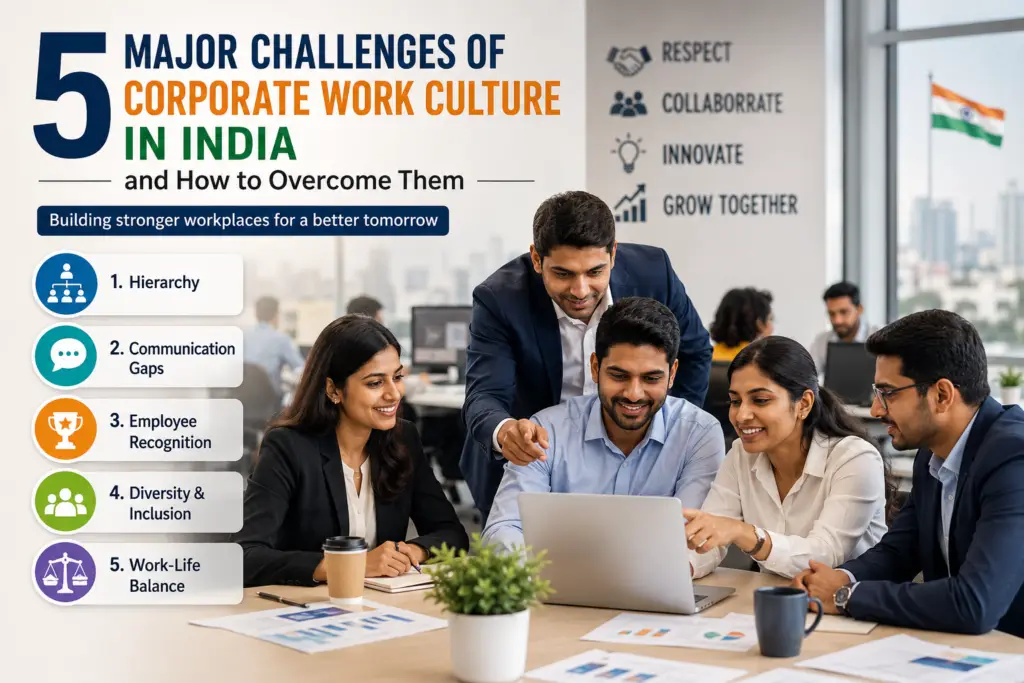
Here are five key challenges organizations need to understand and address.
Corporate work culture in India is evolving as organizations balance traditional values with the expectations of a modern workforce.
1. Hierarchy in Indian Workplaces
Respect for elders is deeply rooted in Indian society. In many Indian families, younger people are traditionally expected to listen to and respect those who are older than them. A disagreement or refusal from a younger person may sometimes be viewed negatively.
A similar pattern can sometimes be seen in organizations.
Age and seniority may influence workplace relationships even when an employee’s official position is determined by skills and responsibilities. This can become particularly challenging when a younger employee holds a senior position or becomes the reporting authority of an older employee.
Such situations can create psychological barriers, ego clashes, and communication difficulties.
At the same time, today’s young professionals bring new ideas, ambition, knowledge, and different ways of approaching problems. Organizations need to create an environment where these ideas can be expressed without making experience and seniority feel undervalued.
How can organizations overcome hierarchical barriers?
Organizations can build healthier workplace relationships by:
- Focusing on roles and responsibilities rather than age.
- Encouraging employees to share ideas regardless of their position.
- Making respectful disagreement acceptable.
- Creating opportunities for younger and experienced employees to learn from each other.
- Encouraging managers to act as mentors and facilitators.
- Building a culture where authority does not prevent open discussion.
A strong corporate hierarchy should provide clarity and leadership without preventing employees from contributing their ideas.
Improving corporate work culture in India requires organizations to respect experience while also creating space for fresh ideas.
2. Communication Gaps in Corporate Culture
Communication is another major challenge in corporate work culture in India.
Traditional communication within families and social settings has often followed a top-down pattern, where elders provide advice and younger members listen. However, the expectations of today’s workforce are changing.
Young Indian professionals are increasingly educated, ambitious, and exposed to new ideas and technologies. They want to contribute their opinions, experiment with new approaches, and have a meaningful role in the everyday functioning of their teams.
When communication within an organization remains mostly one-way, employees may feel that their suggestions and concerns are not being heard.
This can limit creativity, reduce participation, and create distance between managers and their teams.
How can companies improve workplace communication?
Organizations can encourage better communication by:
- Creating regular opportunities for team discussions.
- Encouraging employees to share suggestions.
- Making feedback a two-way process.
- Training managers to listen actively.
- Providing safe channels for employees to raise concerns.
- Encouraging open discussions within teams.
Communication is not simply about speaking. It is also about listening.
When employees know that their ideas are genuinely considered, they are more likely to participate and contribute to the organization’s growth.
Strong communication is essential for building a healthy corporate work culture in India.
3. Employee Recognition and Rewards
Recognition is an important part of creating a positive corporate work culture in India.
In many Indian families, appreciation has traditionally been expressed less openly. People may contribute significantly to their families or communities without receiving regular verbal recognition. However, this is gradually changing, particularly among younger and urban families.
The same shift can be seen in the corporate environment.
Employees want to know that their efforts and contributions are noticed. While salary and financial benefits remain important, appreciation and recognition can also have a significant effect on employee motivation and engagement.
Managers and team leaders have an important responsibility to recognize the value that individual employees bring to their teams and organizations.
Why is employee recognition important?
Timely recognition can help:
- Improve employee motivation.
- Increase employee engagement.
- Build confidence.
- Encourage better performance.
- Strengthen relationships between employees and managers.
- Create a more positive workplace environment.
Recognition does not always have to involve a large financial reward.
A sincere “well done,” appreciation during a team meeting, constructive feedback, or acknowledging an employee’s contribution can make people feel valued.
Employees who feel appreciated are more likely to feel connected to their work and organization.
Employee recognition can therefore play an important role in strengthening corporate work culture in India.
4. Diversity and Inclusion in the Indian Workplace
India is a highly diverse country, and this diversity is naturally reflected in its workplaces.
Employees may come from different communities, religions, genders, social backgrounds, age groups, and abilities. This diversity can be a significant strength because people with different experiences and perspectives can bring different ideas to an organization.
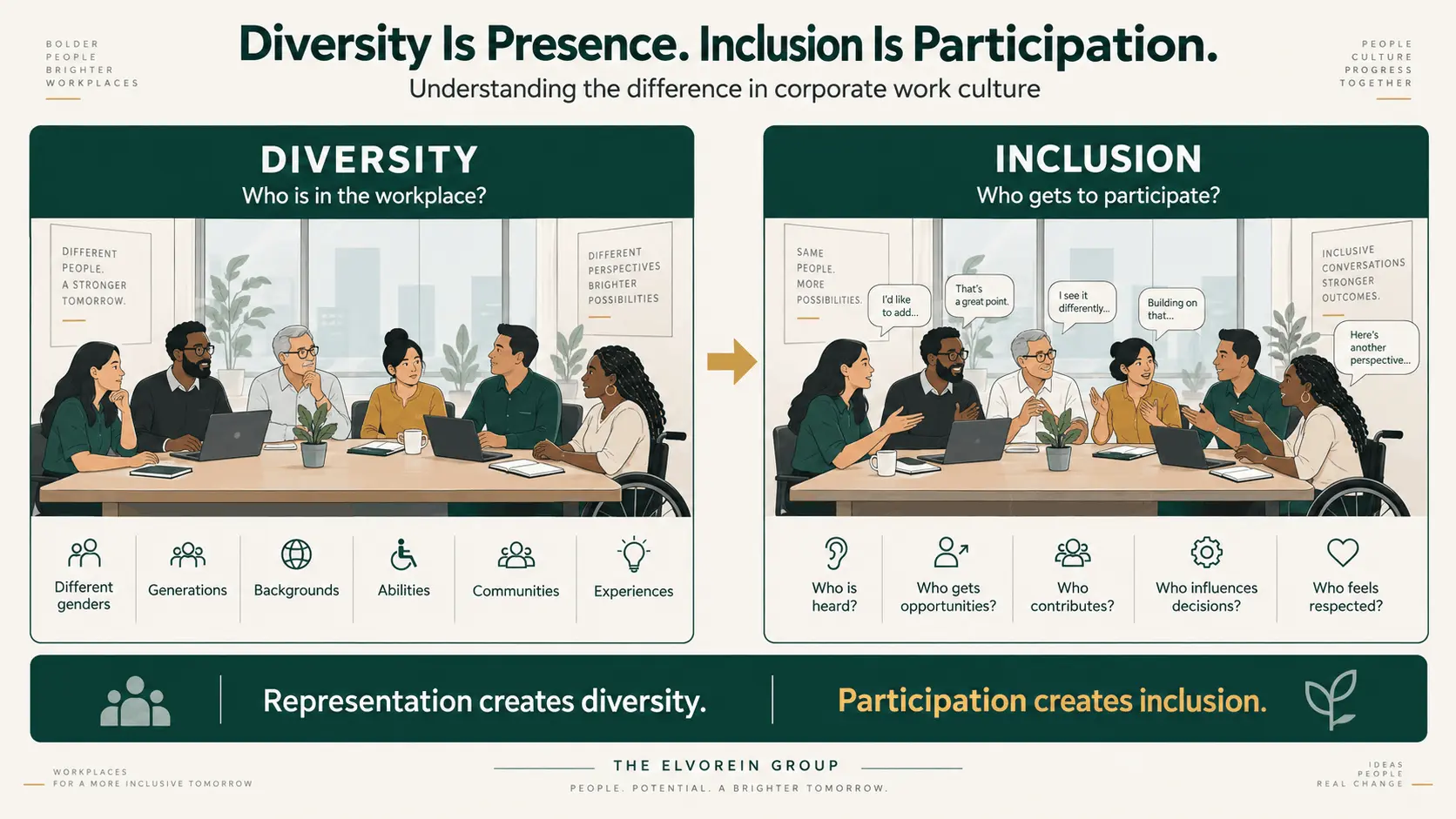
However, diversity can also become a workplace challenge when discrimination, unconscious bias, or social barriers influence employee relationships.
The original concern is not simply about having diverse employees. It is about creating an environment where everyone receives respect, equal opportunity, and the ability to contribute.
How can organizations build an inclusive workplace?
Companies can promote diversity and inclusion by:
- Conducting diversity and awareness training.
- Encouraging open and respectful conversations.
- Providing equal opportunities to employees.
- Creating supportive workplace policies.
- Addressing discrimination and bias.
- Providing a conducive workplace for women, transgender employees, and people with disabilities.
- Encouraging managers to act as mentors and enablers.
Diversity becomes a true organizational strength when employees feel comfortable being themselves and contributing their perspectives.
Diversity brings different people together; inclusion makes sure everyone has a voice.
A more inclusive approach can help organizations build a stronger corporate work culture in India where employees feel respected and valued.
5. Work-Life Balance
Work-life balance is one of the most important challenges in today’s corporate environment.
Indian society places considerable importance on family and togetherness. Family responsibilities can therefore be an important part of an employee’s life. At the same time, employees are expected to contribute professionally and help their organizations achieve their goals.
The challenge arises when organizations expect employees to be available all the time.
Employees are professionals, but they are also individuals with families, personal responsibilities, and priorities outside work. Organizations that want to attract and retain talented employees need to recognize this reality.
Work-life balance does not mean that work and personal life must always be divided equally. Instead, it means giving employees reasonable flexibility to manage important responsibilities while meeting professional expectations.
How can organizations support work-life balance?
Companies can consider:
- Flexible working hours where possible.
- Work-from-home options when appropriate.
- Flexibility during family emergencies.
- Respect for employees’ personal time.
- Avoiding unnecessary late-evening meetings.
- Supportive managers who understand genuine family responsibilities.
- Giving employees reasonable flexibility in how and when work is completed.
For example, if an employee needs to care for a sick child or deal with an important family responsibility, reasonable flexibility can allow them to handle the situation without compromising their long-term professional commitment.
A healthy workplace understands that supporting employees as people can also support the organization as a whole.
Supporting employee well-being is becoming increasingly important to corporate work culture in India.
Building a Better Corporate Work Culture in India
The five challenges discussed above are closely connected.
A workplace with a rigid hierarchy may discourage open communication. Poor communication may make employees feel ignored. A lack of recognition can reduce motivation, while discrimination can damage trust and belonging. At the same time, excessive work pressure can affect an employee’s ability to maintain a healthy personal life.
The solution is not to reject traditional values but to adapt them to the needs of the modern workplace.
Organizations can create a stronger corporate work culture in India by:
- Respecting experience while encouraging fresh ideas.
- Replacing one-way communication with meaningful conversations.
- Recognizing employees for their contributions.
- Creating inclusive and respectful teams.
- Providing reasonable flexibility for personal responsibilities.
- Training managers to become better listeners and mentors.
Managers and team leaders have a particularly important role in this process. Their ability to listen, communicate, recognize contributions, respect suggestions, and respond to employee concerns can have a direct impact on corporate work culture in India.
A successful workplace culture should not simply focus on productivity. It should also focus on trust, communication, inclusion, recognition, and employee well-being.
Conclusion
Corporate work culture in India is evolving.
Traditional values continue to influence workplace relationships, while a new generation of professionals is bringing different expectations, ideas, and approaches to the workplace.
Hierarchy, communication, employee recognition, diversity and inclusion, and work-life balance are five important challenges that organizations need to address.
The goal is not to remove traditional values but to create a workplace where those values work alongside modern organizational needs.
Respect should exist alongside openness.
Authority should exist alongside collaboration.
Performance should exist alongside recognition.
Diversity should exist alongside inclusion.
Professional commitment should exist alongside respect for personal life.
Ultimately, a great workplace is one where employees feel respected, heard, valued, included, and supported.
Building such an environment is essential for creating a sustainable and positive corporate work culture in India.
“Being a great place to work is the difference between being a good company and a great company.” — Brian Kristofek, President and CEO, Upshot
Frequently Asked Questions
What is corporate work culture in India?
Corporate work culture in India refers to the values, beliefs, behaviors, communication styles, workplace practices, and relationships that influence how employees and organizations work together.
What are the five major challenges of corporate work culture in India?
The five major challenges discussed in this article are hierarchy, communication gaps, employee recognition, diversity and inclusion, and work-life balance.
Why is communication important in the workplace?
Effective communication allows employees to share ideas, provide feedback, raise concerns, and participate more actively in organizational decision-making. It is therefore an important part of developing a positive corporate work culture in India.
How can companies improve employee recognition?
Companies can improve recognition through timely appreciation, constructive feedback, rewards, and acknowledgment of employees’ contributions.
Why is diversity and inclusion important in the workplace?
An inclusive workplace helps employees from different backgrounds feel respected and provides them with opportunities to contribute to the organization.
How can organizations improve work-life balance?
Organizations can support work-life balance through reasonable flexibility, work-from-home options where appropriate, flexible timings, and respect for employees’ personal responsibilities.