
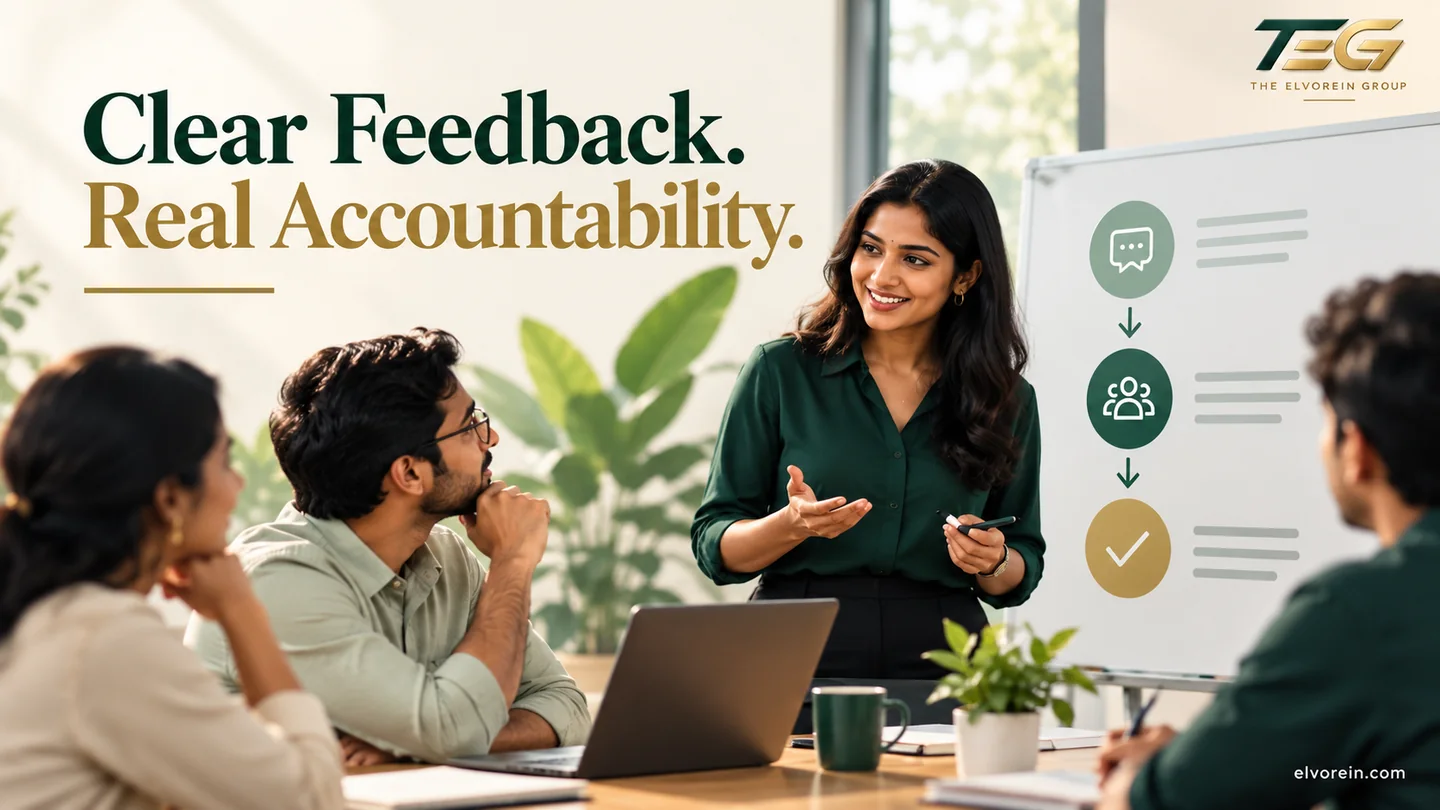
Manager feedback training in Odisha should help leaders discuss observable work, understand the employee’s perspective and agree a clear next action. Accountability becomes more practical when expectations, authority and support are explicit. A difficult conversation should end with shared understanding of what happens next, who owns it and when progress will be reviewed.
Consider an illustrative operations meeting in Berhampur. A director says the team needs more ownership because a customer issue remained unresolved. The supervisor says another department delayed approval. The employee says nobody explained who could authorise the response. The meeting ends with a warning to “be more accountable.”
The language is strong, but the instruction is weak. Everyone can agree with accountability while imagining a different responsibility. A useful leadership intervention makes the work and the decision visible.Manager feedback training in Odisha can help organisations address these situations by teaching managers to clarify responsibilities, communicate expectations and establish practical follow-up actions.
Why managers need better conversations in changing workplaces
The World Economic Forum’s Future of Jobs Report 2025 includes leadership and social influence among significant employer skill priorities. For a local manager, that becomes a practical question: can I help someone understand and improve their work without creating unnecessary defensiveness?
Changing tools and processes can increase the number of conversations about expectations. A person may need to explain how they checked a draft, why they escalated an exception or what they need from another department. Managers need enough clarity to assess those decisions fairly.For HR and L&D teams, manager feedback training in Odisha offers an opportunity to develop consistent communication practices that reflect actual workplace responsibilities.
These are editorial applications of broader research, not evidence that employees in Cuttack, Puri or Berhampur behave in a particular way. A credible programme investigates the team’s actual situations.
Performance conversations work better when both people can describe the agreement that existed before the problem. For leadership development in Odisha, use those conversations to practise fair judgement, listening and a next action that the employee can realistically carry out.
Begin with the agreement that existed before the problem
Before giving feedback, ask what the employee was expected to deliver. Was the standard explained? Was the deadline realistic? Were dependencies and decision limits clear? What changed after the assignment began?
If there was no shared expectation, acknowledge that. A manager can say the task required a clearer briefing and then establish the standard for the next attempt. This does not remove responsibility; it makes responsibility fairer.An important component of manager feedback training in Odisha is helping supervisors distinguish unclear instructions from genuine performance concerns before assigning responsibility.
Collect relevant evidence rather than a long list of frustrations. A work sample, documented commitment or specific observed event is more useful than “people are saying.” Protect customer and employee privacy when using examples for learning.
Choose an appropriate setting. Correcting someone publicly may discourage questions and turn the conversation into a defence of status. Most developmental feedback deserves a private, focused discussion.
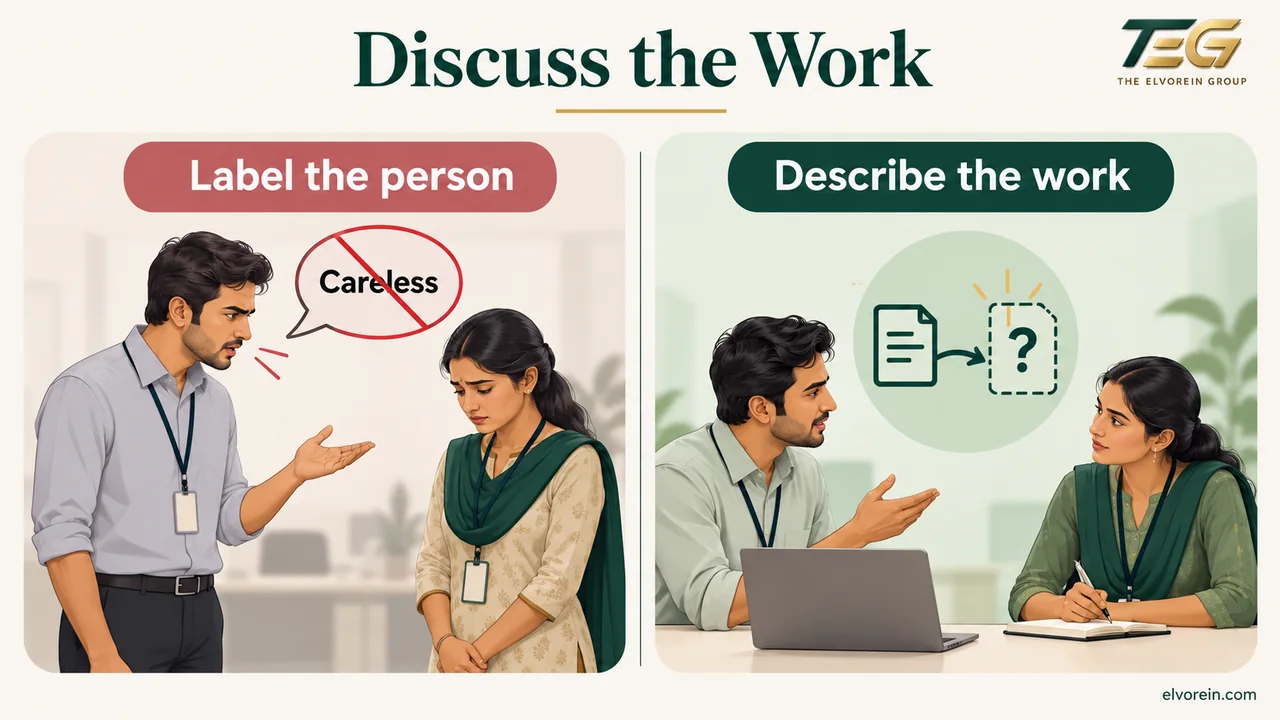
Describe the work without labelling the person
Compare two openings: “You have a careless attitude” and “The handover did not include the unresolved complaint, so the next colleague had to contact the customer again.” The second gives the employee something concrete to examine.
Explain consequences proportionately. Avoid exaggerating one incident into a prediction about someone’s entire career. The manager’s job is to establish the issue and help determine an appropriate response.
Then ask what happened. The answer may reveal a skill gap, a workload conflict or a misunderstanding. Listen before choosing the intervention. A person who lacks practice needs a different response from someone who knowingly ignores a clear instruction.
Feedback training should include this diagnostic stage. Otherwise managers may learn a polished script that still leads them to the wrong conclusion.Effective manager feedback training in Odisha should therefore include realistic role-play exercises where participants practise describing observable behaviour instead of making personal judgements.
Agree an action that can be observed
“Improve your attitude” is difficult to act on and difficult to assess. “Include the pending request, promised date and next owner in every handover” is more specific.
Ask the employee to suggest a workable action. They may know a simpler way to prevent the problem. Check that the plan addresses the cause rather than adding another form that people complete without using.
Agree what support is required. A new employee might need a demonstration. A supervisor might need authority to resolve routine exceptions. A team might need access to information held by another department.
Close by confirming responsibility and review timing. Both people should be able to explain the agreement in similar terms. Send a proportionate written summary when useful, following the organisation’s own practices for records and confidentiality.Through manager feedback training in Odisha, supervisors can practise converting general performance concerns into specific commitments with clear ownership, appropriate support and review dates.

Handle cross-department accountability without a blame contest
In the illustrative Berhampur case, ask each function to describe its handover and decision requirements. Map where the customer issue stopped moving. The problem may sit between roles rather than within one person’s effort.Manager feedback training in Odisha can also incorporate cross-functional scenarios that help participants identify unclear handovers, delayed approvals and overlapping decision-making responsibilities.
Define what a complete request contains, who decides, how quickly acknowledgement is expected and where an unresolved issue goes. Confirm that the receiving team agrees to the arrangement.
For a Cuttack–Bhubaneswar operation, the same exercise can clarify responsibilities across sites. Physical distance is only one possible complication; different assumptions about priorities can be equally disruptive.
Senior leaders should model shared problem-solving. If they reward departments for defending their own record while the customer waits, a communication workshop will struggle to change the underlying behaviour.

Practise the employee’s disagreement
A realistic feedback exercise should include a response the manager does not expect. The employee may challenge the deadline, describe inconsistent treatment or identify a decision the manager delayed.
The manager should be able to distinguish new information from avoidance. Ask for examples, clarify what can be verified and revise the assessment when the evidence warrants it. Fairness requires the possibility that the manager’s first interpretation was incomplete.Including difficult conversations in manager feedback training in Odisha allows participants to practise active listening, evidence-based judgement and constructive responses to disagreement.
When the issue involves a formal grievance, harassment allegation or other sensitive concern, use the relevant organisational route. A feedback conversation should not replace an appropriate process or pressure someone to resolve a serious matter informally.
This boundary belongs in manager training. Knowing when to seek HR support is part of leadership competence.
Build a routine that prevents surprises at appraisal time
Use regular work conversations to discuss progress and obstacles. Keep them focused: what was agreed, what happened, what has changed and what decision is needed now? This reduces reliance on memory during a later review.Manager feedback training in Odisha should encourage regular check-ins so employees receive useful guidance throughout the year rather than discovering unresolved concerns during annual appraisals.
Recognise effective behaviour as specifically as you discuss problems. Explain what the person did and why it helped. Recognition becomes more useful when employees understand which actions they can repeat.
HR can periodically review whether managers apply standards consistently. Look for differences in access to feedback, development assignments and support. Avoid assuming that a completed meeting calendar proves the conversations were useful.
A senior manager in Nayapalli and a service supervisor in Puri may need different examples, but both benefit from clear expectations and timely discussion.
Evaluate the quality of the agreement
After training, assess anonymised scenarios using a simple rubric. Did the manager describe evidence, listen, identify a feasible action and arrange follow-up? Did they recognise when the issue required additional support?To evaluate manager feedback training in Odisha, HR teams can observe practice conversations, review the quality of agreed actions and assess whether managers apply the techniques consistently.
In workplace reviews, look for fewer repeated misunderstandings and better completion of agreed actions. These are potential indicators, not promised outcomes. Consider process changes and workload before attributing an improvement to training.
The Elvorein Group’s Leadership Development service is relevant for discussing feedback, decisions and people-management responsibilities. If the problem also involves role boundaries, explore Organisational Development when sharing your requirements.
When planning manager feedback training in Odisha, organisations should prioritise the situations their managers actually face, select relevant practice exercises and provide opportunities for follow-up learning.
Manager feedback training: a practical review checklist
- Define the situation participants need to handle.
- Use a relevant, non-identifying work or learning example.
- Agree the behaviour or decision that should improve.
- Confirm who will support application afterwards.
- Review evidence and revise the next step.
Frequently asked questions
What is the difference between feedback and accountability?
Feedback provides information about work and its effects. Accountability establishes who is responsible for an outcome or action. They work together when a manager explains the issue, checks understanding and agrees an action the employee has the ability and authority to carry out.
How should a manager respond when an employee disagrees?
Ask for specific information and examine it before deciding. The employee may reveal a missed dependency or unclear instruction. The manager can maintain an appropriate standard while correcting an incomplete assessment or changing an unrealistic plan.
Can feedback training help senior managers?
Yes. Senior managers also need to clarify expectations, hear unwelcome information and discuss missed commitments. Their behaviour influences what other managers copy. Practice should reflect their decision authority and the consequences of their conversations.
Should all performance issues be handled informally?
No. Some matters require formal HR, grievance or other organisational procedures. Managers should know those boundaries and seek appropriate support. Developmental feedback should not be used to bypass a process intended to protect fairness or confidentiality.
How can HR choose scenarios for a leadership workshop?
Use anonymised, recurring situations involving real responsibilities. Remove identifying details and avoid turning an active employee case into a classroom exercise. Include ambiguity and disagreement so managers practise reasoning and listening as well as speaking.
Related reading: First-Time Manager Training: A Practical Bhubaneswar Guide.
