

Corporate training needs analysis in Bhubaneswar should begin with a business problem, evidence from everyday work, and a clear description of the behaviour that needs to change. Effective corporate training in Bhubaneswar begins with understanding the actual workplace challenge rather than immediately scheduling a workshop.HR should separate skill gaps from workload, process and authority problems before selecting a programme. This makes the training brief more useful to employees, managers and the business sponsor.
Consider an illustrative situation: a growing services company in Bhubaneswar receives repeated client complaints about late updates. Its founder asks HR to arrange communication training. Employees say they already send updates, but three managers change priorities throughout the day. The training request sounds clear. The actual problem still needs investigation.
This distinction matters for organisations recruiting, introducing new tools or adding reporting layers. A workshop can help people practise a difficult conversation. It cannot independently decide which manager has the final say over a deadline.
What current skills research means for a local HR team
The World Economic Forum’s Future of Jobs Report 2025 skills outlook identifies analytical thinking, resilience and leadership among important employer priorities. It reflects surveyed employers across markets, rather than a measurement of Bhubaneswar companies.For organisations planning corporate training in Bhubaneswar, these skill priorities should be translated into practical, role-specific learning objectives.
The practical implication is to examine how those skills appear in a particular role. Analytical thinking for an account manager might mean distinguishing a customer complaint from its underlying cause. For a supervisor, resilience might mean responding constructively when a shift plan changes. A broad skills label becomes useful only after the organisation defines an observable task.
For a team around Infocity, that task might involve explaining a delivery risk. For an office in Sahid Nagar, often searched as Saheed Nagar, it might involve clarifying a customer request. These are possible training contexts, rather than claims about businesses in those locations.
A learning needs assessment is useful when it turns a broad request into a specific work question. For corporate training in Bhubaneswar, compare employee accounts, manager expectations and anonymised examples before deciding what participants should practise.
Step one: write a performance question the sponsor can answer
Replace “improve communication” with a more specific question: can team leads give a complete, timely escalation when a commitment becomes uncertain?
A useful brief identifies the participants, the situation, the expected response and the evidence. For example: project coordinators should flag a likely delay before a client has to chase, using an agreed update format. The evidence could be a sample of recent project communications, with personal and customer details removed.
Agree whose decision the programme supports. A founder may care about repeat business. An HRBP may care about inconsistent manager practices. A delivery head may care about avoidable rework. Those priorities can connect, but someone must choose the first outcome to address.
Keep the initial scope manageable. A programme expected to solve leadership, retention, service quality and culture simultaneously will be difficult to design and almost impossible to assess fairly.
Step two: investigate work before judging people
Speak with a small cross-section of managers and employees. Ask each person to describe a recent incident, what they understood, what happened next and what made a better response difficult. Avoid questions that already contain an accusation, such as “Why do employees lack ownership?”
Review the workflow alongside the interviews. Does the person have access to the required information? Can they make the decision? Is there a standard for a good handover? Are two departments rewarded for incompatible outcomes?
The CIPD learning needs analysis guidance supports connecting learning needs with organisational and individual requirements. For local HR teams, the useful discipline is triangulation: compare what people report with work examples and manager expectations.
If every employee makes the same mistake at the same approval stage, investigate the process. If expectations are clear but people struggle to carry out the conversation, practice and feedback may be appropriate. Many situations require both changes.

Step three: turn the diagnosis into a programme brief
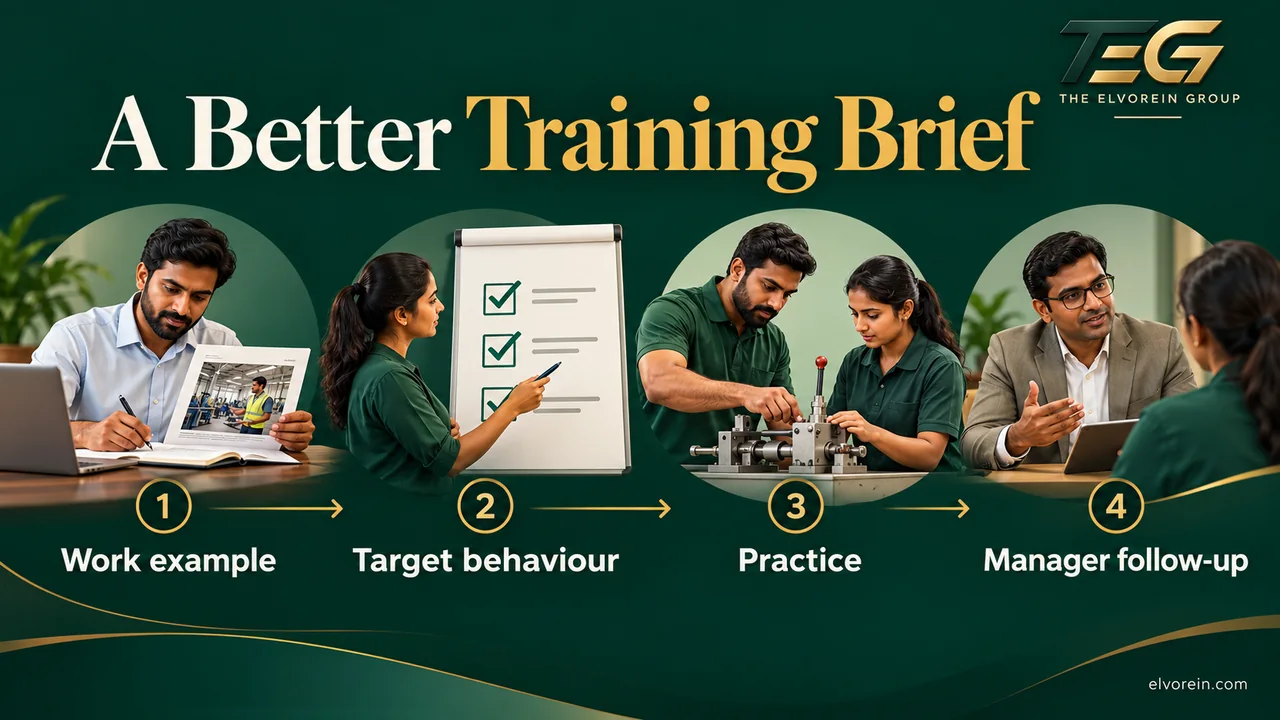
Build the brief around three or four behaviours. A customer communication programme could focus on clarifying the request, confirming ownership, communicating uncertainty and closing the loop. Each behaviour should have an example of acceptable performance.
Include realistic constraints. Employees may need to speak in Odia during internal discussion and produce an English update for a client. A role-play can accommodate both. Language confidence and reasoning quality should be observed separately so that fluent delivery does not hide a weak decision.
For teams commuting between Cuttack and Bhubaneswar, ask about feasible session timing instead of assuming everyone can stay late. For dispersed teams, decide whether online practice, smaller groups or repeated sessions will make participation more realistic.
Choose formats after defining the work. A facilitated discussion suits reflection; a simulation tests application; a manager check-in supports follow-through. Presentation slides alone provide limited evidence of changed behaviour.
Step four: ask managers to create room for application
Training transfer depends on what happens after the session. Ask the line manager to identify one real situation in which participants can use the learning during the following week.
For example, employees might use a new escalation template in an existing project review. The manager then comments on whether the update explained the issue, its consequences, the proposed action and the decision required. Feedback should be specific enough to improve the next attempt.
This approach also exposes contradictions. If a workshop encourages early escalation but managers criticise anyone who raises uncertainty, employees receive two competing instructions. HR should address that inconsistency with the sponsor.
Agree what support the manager needs. A short briefing, an observation guide and permission to adjust an unhelpful process may matter more than asking them to send another reminder email.
Step five: measure a useful change without overstating causation
Start with a baseline. Sample a manageable number of handovers or customer updates before the programme, then review a comparable sample afterwards. Use the same criteria and explain any changes in workload or staffing.
Training attendance shows participation. A satisfaction survey shows experience. Neither establishes that a team now performs the task well. Add an observed practice task and a later workplace check.
For the illustrative company, useful measures might include completeness of escalation messages, time between identifying a risk and reporting it, and recurring clarification requests. These are proposed measures, not results achieved by Elvorein.
Avoid attributing every improvement to the workshop. A new manager, revised process or quieter delivery period may also affect results. A credible evaluation describes the contribution of learning alongside these other influences.

How should geography influence the training plan?
Use locality to make the programme convenient and relevant. Nayapalli, Baramunda and Sahid Nagar may help define travel and scheduling needs. Infocity and Patia can provide a recognisable setting for corporate examples. They should not become assumptions about a company’s culture or maturity.
The same diagnostic method can support organisations in Cuttack, Puri and Berhampur, also known as Brahmapur. The workflow should determine the content. A hotel reception team, a college office and a technology delivery team need different practice scenarios even when all request communication training.
The Elvorein Group’s Corporate Training & HR Strategy service is a relevant starting point for discussing learning priorities. Bring an anonymised work example, participant roles and the outcome you want to improve to the programme discussion.
Training needs analysis: a practical review checklist
- Define the situation participants need to handle.
- Use a relevant, non-identifying work or learning example.
- Agree the behaviour or decision that should improve.
- Confirm who will support application afterwards.
- Review evidence and revise the next step.
Frequently asked questions
What is the first step in planning corporate training in Bhubaneswar?
Define a specific performance problem and gather examples before choosing a topic. Ask what employees need to do differently, whether they have the authority and resources to do it, and how the organisation will recognise improvement.
Should a small business conduct a formal training needs analysis?
A small business can use a proportionate version: a sponsor discussion, a few employee interviews and several anonymised work samples. The purpose is better decisions, rather than producing a lengthy report or adding unnecessary administration.
Can one programme cover employees from Bhubaneswar and Cuttack?
Yes, if their roles and learning needs are sufficiently similar. Check travel, shift coverage, accessibility and opportunities to practise. Separate groups may be more useful when job responsibilities differ substantially, even if the employees share an employer.
How quickly should HR evaluate a programme?
Evaluate understanding during the session and application after employees have had a reasonable chance to use the skill. A review after several weeks is a planning option, not a universal standard. Match the timing to the frequency of the task.
Does corporate training guarantee improved retention or productivity?
No. Outcomes depend on job design, leadership, pay, resources and other conditions as well as capability. Set realistic learning objectives and evaluate relevant behaviour. Discuss broader business indicators with appropriate caution about what caused a change.
Related reading: HR Strategy for Growing Companies in Odisha: A Practical Guide.
